Moave
.
.
.

The Bridge
Erasmus+ training course
2. - 9. November 2026
Slovenia
the art of crossing

The Bridge: The Art of Crossing is a 6-day Erasmus+ training course that explores the bridge as a living metaphor for connection, relationality, and support.
A bridge is not built from strength alone. It exists through a dynamic relationship between foundations, materials, tension, movement, and balance.
It is a structure that allows two different shores to remain connected while honouring the distance between them.
Inspired by somatics, ecopsychology and systemic approaches, this training explores the bridge as an embodied practice of relating — to ourselves, to others, to communities, and to the more-than-human world.
A bridge is not created by one shore reaching towards the other alone. It emerges through relationship, through meeting, through the willingness to enter the space in-between. In this shared space, new possibilities arise — where differences can coexist, where belonging can grow, and where transformation becomes possible.

THE BRIDGE
THE CONNECTION, THE LINK, THE GATE
Bridges are built to connect two worlds. They create flow, allowing us to travel between realms, ideologies, person-alities. This archetype is the gesture of acceptance, of saying yes rather than withdrawing, separating, and saying no.
When we cross a bridge to an unknown land, we are led magically into a new reality.
We open up to otherness.
Remember that a bridge can't be forced. It must be made with love, or its structure will not withstand the inevitable weather of life.
Kim Krans
About this training
The training invites participants to explore their own relational patterns and ways of creating connection. Through movement, sensory awareness, nature-based practices, systemic work, creative processes, and group experiences, we will investigate the invisible architecture of relating.
Together, we will explore the symbolic wisdom of the bridge and what it teaches us about connection, transition, and meeting across differences. The bridge reminds us that crossing is not only about reaching another shore; it is about how we travel through the space in-between. It teaches us to stay present while moving through uncertainty, to trust support without losing our own ground, and to remain open to growth that happens through encounter.
The art of crossing is the ability to move between inner and outer worlds, between self and other, between what is familiar and what is not yet known. It invites us to cultivate balance, listening, flexibility, and relational presence. Through this exploration, participants will discover how bridges can become living pathways of connection, belonging, and mutual transformation — both in their personal lives and in their work with young people and communities.
A bridge needs strong foundations.
In the same way, our capacity to connect with others is rooted in our relationship with ourselves. We will explore the embodied resources that support us in meeting others: grounding, boundaries, listening, vulnerability, curiosity, and the ability to stay present with uncertainty.
A bridge also needs flexibility.
It must respond to movement, weather, and changing conditions. Similarly, relationality requires adaptability—the ability to listen, to adjust, and to remain open to what emerges in the encounter.
Through this training, we will explore how our own embodied presence influences the relationships we create. How do we approach young people? From where do we meet them? Are we building bridges that allow them to cross towards themselves and others, or are we unconsciously asking them to cross towards us?
The bridge is not built from one side only.
It is created through encounter.
Fascia
A bridge does not stand because every part is rigid and independent.
It stands because every element is in relationship with the others.
A bridge is not held together by strength alone; it emerges through a dynamic relationship of support, tension, responsiveness, and balance. In this way, the bridge reflects the wisdom of the fascial system; a living, connective tissue network that continuously senses, adapts, and reorganises in relationship with the whole body. Fascia reminds us that stability does not come from rigidity, but from the capacity to move, adjust, and distribute forces through connection.
From a somatic psychology perspective, our inner bridges are also built through relationship — through the ways we experience support, safety, boundaries, and contact. Our bodies are constantly negotiating between holding and letting go, protection and openness, autonomy and connection. Like a bridge, our nervous system learns resilience not by avoiding tension, but by developing the capacity to stay present within it.
How does this topic relate to youthwork and facilitation?
As youth workers, we are constantly building bridges.
Every interaction with young people is a crossing between different realities, experiences, histories, and worlds. We meet young people at their own shores — their questions, struggles, dreams, and potentials — and we are invited to create spaces where connection becomes possible.
Yet, building a bridge requires humility. We can never fully know the landscape on the other side. Young people today are growing up with different experiences, information, technologies, social realities, and cultural influences than the ones that shaped our own development. The world they are navigating may look unfamiliar to us, and the challenges, opportunities, and pressures they encounter might exist in contexts we have never experienced ourselves.
The role of a youth worker is therefore not to build a bridge that leads young people towards our own shore, but to create a pathway of meeting. It requires curiosity, listening, and the willingness to approach each young person’s reality without assumptions. Through embodied presence and relational awareness, we explore how we can meet young people where they are, recognise their unique landscapes, and support them in finding their own pathways of connection, belonging, and growth.
How does this topic relate to mental health?
From a somatic psychology perspective, mental health is not only located in our thoughts and emotions, but in the ongoing relationship between our body, nervous system, environment, and relationships. We are constantly receiving information from within ourselves and from the world around us, adapting and reorganising in response to our experiences. Our capacity for wellbeing emerges from the ability to stay connected — to our sensations, emotions, needs, boundaries, and to the people and environments we are part of.
In somatic psychology, healing is not understood as removing difficult experiences, but as creating new possibilities for relationship with them. Through embodied awareness, we learn to listen to the wisdom of the body, recognise patterns of protection, and develop greater capacity to stay present with our experiences. Like a bridge that needs both stability and flexibility, our nervous system needs both grounding and adaptability in order to navigate change.

Methodology:
Somatics - Ecopsychology - Dance improvisation
Somatic practices focus on increasing awareness of bodily sensations, movements, and patterns, seeing the body as a source of information and insight. By noticing how we feel, move, and respond in the moment, participants can explore their physical, emotional, and relational states. This awareness supports presence, self-regulation, and resilience, offering tools to navigate uncertainty, tension, and transitions, both personally and in group contexts.
Systemic work explores the individual as part of larger relational systems, recognising that our experiences, patterns, and ways of relating are shaped through family, social, cultural, and collective contexts. Through constellation-inspired exercises and embodied exploration, participants can bring hidden dynamics, connections, and perspectives into awareness. This approach supports a deeper understanding of how we are influenced by the systems we belong to and opens possibilities for new ways of relating, responding, and creating connection.
Imagination and imaginal work engage the symbolic and creative dimensions of human experience, exploring images, metaphors, dreams, and inner landscapes as sources of meaning and transformation.
Ecopsychology explores the relationship between humans and the natural world, emphasising that our well-being is interconnected with the health of the environment. Participants engage with nature as a reflective and relational mirror, exploring transitions, boundaries, and inner states while growing a sense of ecological awareness, interconnection, and responsibility.
Objectives:
Personal Exploration & Sensory Awareness:
-
Develop awareness of bodily sensations, emotions, movement patterns, and internal states as sources of information and insight.
-
Explore personal ways of building inner bridges — between thoughts, emotions, sensations, and experiences — and develop greater capacity for presence, self-regulation, and resilience.
-
Investigate personal patterns of connection, protection, and adaptation, exploring how the body responds when crossing inner and outer transitions.
Interpersonal & Group Connection: -
Explore relational dynamics through somatic practices, movement, voice, and systemic exercises, developing awareness of contact, boundaries, trust, and mutual support.
-
Understand connection as a process of building bridges between different realities, perspectives, and experiences, while cultivating curiosity, empathy, and openness towards others.
-
Develop skills for creating inclusive and supportive spaces where diverse experiences can meet, especially in youth work and group facilitation contexts.
Professional & Facilitation Practices: -
Explore how somatics, ecopsychology, systemic approaches, and creative practices can be integrated into youth work, education, and community-based activities.
-
Experiment with ways of becoming a “bridge-builder” as a facilitator — creating spaces where dialogue, belonging, resilience, and collective learning can emerge.

The bridge is not built over the river;
it is built over the places within ourselves that once believed they could never be crossed.
It does not remove the valley beneath it. It does not erase the distance, the rupture, or the landscape that created the need for crossing. Instead, it teaches us that the valley is no longer the end of the journey. It becomes a place through which movement is possible, a space where connection can emerge.
A bridge honours both shores. It does not ask one side to disappear or become the other. It belongs fully to neither side, yet it allows stories, experiences, and possibilities to flow between them. It creates a space where difference can remain alive while relationship becomes possible.
In the same way, the bridges we build within ourselves and with others are not created by overcoming our fractures, but by learning how to relate to them. They are built through presence, trust, vulnerability, and the courage to meet what lies between us.
A bridge is where two pieces of land agree not to remain strangers.
It is the place where separation becomes encounter, where distance becomes possibility, and where crossing becomes an act of connection.
Join the BRIDGE
The course welcomes participants from diverse professional backgrounds who are curious about integrating somatics, movement, and ecopsychology into youth work and facilitation, creating spaces where transitions, uncertainty, and diversity can be navigated safely and creatively.
The knowledge and practices explored in this training are important for youth workers and facilitators because their work is rooted in building bridges between different worlds. They constantly navigate between individual needs and group dynamics, personal experiences and collective realities, support and challenge, structure and creativity. Their role is to create relational spaces where young people can feel seen, heard, and supported while exploring identity, belonging, uncertainty, and change.
We aim to have 28 participants from Slovenia, France, Germany, Spain, Italy, Romania, Slovakia and Hungary.
Participants must be over 17 years old and have a communicative level in English so that they can participate fully in the program.
Commitment to Outcomes
As part of the Erasmus+ training, participants are expected not only to engage in the 6-day learning process but also to create and share an outcome afterwards, bringing the methodology into wider practice and visibility. This outcome can take a form that best suits each participant’s context and skills, for example:
-
Designing and facilitating a workshop in their local community or organization.
-
Writing and publishing a reflective article, blog post, or report that shares insights from the training.
-
Producing a short video or creative piece that communicates key learnings.
-
Developing other innovative formats (artistic, educational, or digital) to disseminate the experience.
etc.
By committing to this follow-up, participants ensure that the training does not remain a personal journey only, but becomes a shared resource for their communities and professional practice inside your organisation. They bring the lessons from the edge (the ecotone between disciplines, cultures, and methodologies) into real-life contexts, inviting collaboration, inclusion, and relational awareness. Working together with the your organization (our partners on this journey) and partner institutions, you can strengthen the impact of the project beyond the course, creating ripple effects in youth work, cultural practice, and local communities.
Project Partners:
Unfold e.V. - Germany
Participants are expected to be nominated or supported by their sending partner organisations from each country, ensuring that the learning experience is connected to their professional context and local communities.
If you would like to take part in this programme, please make sure to complete and submit the application form carefully and in full. Your application will help us learn more about your background, motivation, and expectations.
and is required in order to be considered for participation.

Important notice before applying:
This training is not a psychotherapy training and does not qualify participants to provide psychological treatment. Instead, it offers an experiential, non-formal education process rooted in ecopsychology, somatics, and movement. Participants will be guided to explore their own experiences through the topic of the course.
The training thus focuses on experience-based learning that supports both professional facilitation skills and personal awareness, strengthening the capacity to offer meaningful, compassionate support in non-clinical settings.
The training course is open to people of all experience levels. However, being open and interested in investigating this approach is important. We expect you to participate in the whole program.
Also, prepare for an intensive experience with at least 6 hours of physical activities every day!
Our work primarily centres around somatic movement practices, somatics, contact Improvisation principles. Participants must be comfortable with giving and receiving touch as a means of learning.
Clarification on Course Purpose:
Please note that this training is not meant to replace psychotherapy or serve as a method of healing. Instead, it provides a learning opportunity for individuals to gain a better understanding and experience which they can later share.

Travel reimbursement - what is the procedure?
Venue information and location - where will we be staying?
Food and insurance - important information
FAQ - what is still unclear?
Practical information
This training course is funded through the Erasmus+ Programme, travel costs up to a specific maximum allowed amount will be fully reimbursed.
Slovenia: 28 EUR (56 EUR for Green Travel*)
Italy: 211 EUR (285 EUR for GT*)
Spain, Romania, Slovakia, France, Germany, Hungary: 309 EUR
(417 EUR for GT)

Meeting the bridge team
Here you can find a short introduction from the team about the topic of The Bridge and what this metaphor represents for us. In this video, we share some of the ideas, questions, and inspirations that will accompany us throughout the training week.
This is an invitation to begin sensing the theme of the training and to enter the week with curiosity, openness, and readiness to explore your own bridges.


Magdaléna is a dance movement therapist working in a private practice. Body, movement, touch and sound are the main entrance points to the realm of the soul. She is amazed by the capability of the human being to overcome even almost unbearable situations and therefore her aim is to empower her clients and guide them on their journey to their own resources and resilience.
Main inspirations on her journey come from movement, nature, contact improvisation, deep listening and shamanism.
"I see a river. I stand on it´s shore. There is noone else. Just me. Standing there, breating. I see it flows and meander here and there, spiraling and waving. It feels alive and conscious. I would love to cross but there is nothing to cross through. It feels so wide, so uncertain, so unstable. So I stand. I feel my frustration, my emotions flow like that river. So I stand. I observe, I breath. Suddenly butterfly comes and fly arround. It brings some lightness and easy. He shows me the way. I follow till I come to an old wooden-rope bridge. Something happen inside and I know I need a courage to pass it. But I make a step. Then another, and another.. more steps I make, more I know this bridge. It carried so many people, so many stories, passed through so many winters. It is older then me and it connects two worlds that are as well older then me. Finally I cross. I stand there and I see myself standing on the other side, listening to the sound of water, wisper of the wind and I know, I am at home."
Živa is an anthropologist, manual therapist and researcher of somatic practices and contact improvisation. Her field of activity focuses primarily on developing and maintaining sensitivity and awareness towards oneself, fellow human beings and the environment, finding organic, creative and non-violent ways for the coexistence of differences and their mutual enrichment, which enables continuous transformation and personal growth. She uses work with the body, touch and awareness of space as the basic tools of her practices.
I like creating spaces where the body becomes a place of listening and connection. I'm interested in the 'bridging systems' we are part of — within ourselves, between one another, and with the more-than-human world. Through somatic exploration, movement, gentle encounters with touch, creative experimentation, and reflective dialogue, I like to invite participants to explore the subtle space where presence, relationship, and perception begin to shift. Inspired by somatics and ecological thinking, I approach facilitation as tending a living ecology of attention, where bodies, words, silence, and surroundings can breathe together. Rather than offering fixed answers, I aim to create conditions where curiosity can unfold, embodied awareness can deepen, and new ways of relating can emerge. I am inspired by the wisdom of fascia—a living connective tissue that supports the body not through rigidity, but through relationship, responsiveness, and continuous adaptation. Like a bridge, fascia distributes tension, offers support, and allows movement while maintaining connection across the whole. In the same way, I see facilitation as cultivating the connective tissue within a group: creating spaces where trust, curiosity, and belonging can grow, where people can remain grounded in themselves while discovering new ways of meeting others. Here, the body becomes both a bridge and a guide, sensing the possibilities that emerge through connection.
Nayeli is a psychologist working privately as a therapist with a Gestalt experiential psychotherapy approach. She has been a trainer in the field of non-formal education for more than 15 years. In the somatic and dance field, she is deeply inspired by contact improvisation, which has shaped her exploration of movement and its somatic approach beyond the dance studio. Having been actively engaged in the practice since 2017, she continues to investigate how this form expands her view on life.
"I see the Bridge as a beautiful metaphor for possibilities — to cross, to connect, to meet, to explore the in-between space, and more.
It offers an opportunity to maintain connection even when we feel separated from something. Through this metaphor, we can practise reaching out, expanding, and also allowing ourselves to remain somewhere without crossing. Grief work is one such space where the metaphor of the Bridge can support healing. Even when we experience an empty space within or between us, there is still something that connects us to the world. What once felt cut off can remain connected in a different way.
To practise the metaphor of the Bridge is to allow ourselves to meet others where they are, not where we wish they would be.
In dance improvisation, we are constantly exploring what in the present moment becomes possible. We are building bridges by staying receptive and open to possibillities they emerge from the present moment."
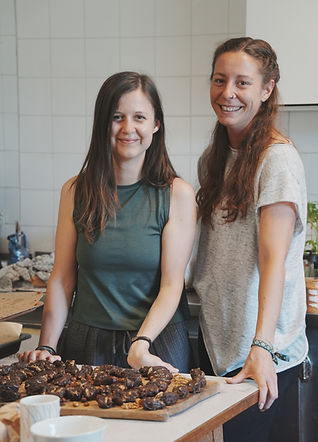
Sabina Vilhelm and Lana Karina Crnohorski
Društvo Koru
Are our caring and nutritious cooking team. They are also passionate dancers and explorers of embodiment practices. Something that can be reflected in their way of cooking:
with presence, care and lots of creativity.

Applications deadline: 1st of September at 12pm
Selection results: 9th of September
Arrival day: 2nd of November by 7pm
Start of the program: 3rd of November
Last day of the program: 8th of November
Departure day: 9th of November by noon
Last drop of information
Project Partners:
Unfold e.V. - Germany