Moave
.
.
.

Ecotone
knowledge of the edge
Erasmus+ training course
2. - 10. June 2026
Slovenia

“In the natural world, places where diverse ecosystems come together are known as ecotones. An ecotone is the edge place where differences come together, where boundaries drop away, where mutual interaction is inevitable.
As a metaphor, the ecotone reflects the meeting place of personal experience and theoretical discourse. It is not wilderness here but even in the domesticated landscapes, with traffic and cities nearby, there are possibilities
to shift realities, to find new ways of seeing.
The image of the intertidal zone is a reflection of possibilities
where different ways of knowing flow together.
It is a methodology of relationship.”
Sylvie Shaw

Knowledge of the Edge
Knowledge of the Edge is a 7-day Erasmus+ training course that explores the edge as a dynamic, living space, a fertile intersection where youth work, culture, somatics and ecology meet and inform one another. Inspired by the ecological concept of the ecotone (the transitional zone between ecosystems where diversity and resilience thrive) this training approaches boundaries not as rigid separations, but as spaces of encounter, dialogue, and growth.
We use the ecotone as a metaphor for human experience, learning, and relational practice. Just as in nature, our personal, social, and cultural boundaries are not rigid walls, but spaces of encounter where growth and insight happen. In these liminal spaces, we exist in a shared field of possibility. This is the “in-between” where relationships are alive, knowledge is co-created, and the body, mind, and environment interact as a dynamic system.

About this training
Ecology teaches us that edges are zones of exchange and vitality.
Similarly, healthy professional boundaries are dynamic and responsive,
allowing connection without collapse, autonomy without isolation.
This training cultivates the ability to inhabit these edges consciously,
to work from them rather than avoid them.
Central to the training is the exploration of boundaries. A boundary is not only a line that separates; it is also a place of contact. It defines identity while making relationships possible.
In this training, the edge is not an abstract concept. It is a practice. Participants are invited to sense where boundaries appear in their bodies, in relationships, in group dynamics, and in institutional structures. Through movement, voice, reflective dialogue, and embodied inquiry, they will explore what it means to stand in the in-between: between certainty and curiosity, leadership and listening, individuality and belonging, structure and improvisation.
By inhabiting these transitional spaces, participants learn to recognize the subtle signals of change — moments of tension, resistance, creativity, and connection. They practice staying present at the threshold rather than rushing to resolve it. This capacity is essential in youth work and facilitation, where growth often happens at the edge of comfort, identity, and worldview.
How does this topic relate to youthwork and facilitation?
Youth work often emphasises dialogue, participation, and social learning.
Somatics emphasises embodied awareness, sensation, and internal regulation.
At their intersection, something new emerges:
Youth work becomes more embodied and regulated.
Somatic practice becomes socially engaged and community-oriented.
In a time of increasing polarisation, mental health challenges, and ecological anxiety, youth workers need more than technical methods; they need relational intelligence, psychological flexibility, and the ability to stay grounded in uncertainty. Understanding how to work “at the edge” helps them support resilience, inclusion, and authentic participation. It allows them to transform moments of discomfort into opportunities
for growth and to turn diversity into a source of creativity
rather than division.
How does this topic relate to mental health?
This training topic connects to mental health and belonging by exploring how individuals and groups navigate boundaries (personal, relational, and social). Healthy mental wellbeing depends on the ability to recognise limits, stay connected without losing oneself, and tolerate difference and uncertainty. By working with the concept of the edge as a space of encounter rather than separation, participants learn to create environments where growth can happen safely at the boundary between comfort and challenge. Through somatic and relational practices, they strengthen emotional awareness, self-regulation, and psychological flexibility, essential capacities for resilience. At the same time, the training addresses belonging by supporting the creation of spaces where diversity is welcomed, and individuals can remain authentic while being part of a community. In this way, boundaries become not barriers, but meeting places that foster both individual well-being and inclusive connection.

In a social and political context, the ecotone represents the living space where differences meet, between cultures, generations, identities, institutions, and worldviews. These edges are often places of tension, but also of creativity and social innovation. Youth work itself operates in such transitional zones, mediating between young people and systems, private experience and public life.
By understanding and working consciously at these edges, facilitators can transform boundaries from rigid divisions into spaces of dialogue, inclusion, and democratic participation. In this sense, learning to inhabit the ecotone supports social cohesion, pluralism, and the capacity to engage
constructively with complexity and difference.
Methodology:
Somatics - Ecopsychology - Dance and vocal improvisation
Somatic practices focus on increasing awareness of bodily sensations, movements, and patterns, seeing the body as a source of information and insight. By noticing how we feel, move, and respond in the moment, participants can explore their physical, emotional, and relational states. This awareness supports presence, self-regulation, and resilience, offering tools to navigate uncertainty, tension, and transitions, both personally and in group contexts.
Dance and Voice Improvisation are spontaneous practices where movement and vocal expression emerge in the moment, without predetermined structure. These practices invite participants to explore physicality, creativity, emotion, and relational attunement, responding to stimuli such as rhythm, breath, space, and the energy of others in the group. Improvisation becomes a way of inhabiting the edge, noticing what emerges in the in-between of structure and freedom.
Ecopsychology explores the relationship between humans and the natural world, emphasising that our well-being is interconnected with the health of the environment. Participants engage with nature as a reflective and relational mirror, exploring transitions, boundaries, and inner states while growing a sense of ecological awareness, interconnection, and responsibility.
Objectives:
Personal Exploration & Sensory Awareness:
-
Notice and attune to bodily sensations, movements, and internal states.
-
Explore how awareness of the body and emotions can support presence, reflection, and resilience in transitional or uncertain spaces.
Interpersonal & Group Connection:
-
Observe and experiment with relational dynamics through movement, voice, and shared experiences.
-
Explore how attending to boundaries, edges, and attunement can support collaboration, empathy, and inclusive environments in youth work and community facilitation.
Professional & Facilitation Practices:
-
Explore ways to integrate somatics, improvisation, and ecopsychology into workshops, youth work, and educational activities.
-
Experiment with approaches that help participants, groups, and communities navigate transitions, tension, and change with awareness and creativity.

The intention of this training is to support youth workers, facilitators, and educators in exploring and practising embodied, relational, and interdisciplinary approaches for working with young people at the edges of experience, learning, and identity.
The course welcomes participants from diverse professional backgrounds who are curious about integrating somatics, movement, voice, and ecopsychology into youth work and facilitation, creating spaces where transitions, uncertainty, and diversity can be navigated safely and creatively.
The knowledge of this training is important for youth workers and facilitators because they constantly operate at the edges, between individuals and groups, safety and challenge, structure and freedom, conflict and connection. Their role requires holding spaces where young people explore identity, difference, belonging, and uncertainty. Without awareness of how boundaries function (psychologically, relationally, and somatically) it becomes difficult to create environments that are both safe and supportive.
We aim to have 27 participants from Slovenia, France, Germany, Spain, Italy, Romania and Hungary.
Participants must be over 17 years old and have a communicative level in English so that they can participate fully in the program.
Commitment to Outcomes
As part of the Erasmus+ training, participants are expected not only to engage in the 7-day learning process but also to create and share an outcome afterwards, bringing the methodology into wider practice and visibility. This outcome can take a form that best suits each participant’s context and skills, for example:
-
Designing and facilitating a workshop in their local community or organization.
-
Writing and publishing a reflective article, blog post, or report that shares insights from the training.
-
Producing a short video or creative piece that communicates key learnings.
-
Developing other innovative formats (artistic, educational, or digital) to disseminate the experience.
etc.
By committing to this follow-up, participants ensure that the training does not remain a personal journey only, but becomes a shared resource for their communities and professional practice inside your organisation. They bring the lessons from the edge (the ecotone between disciplines, cultures, and methodologies) into real-life contexts, inviting collaboration, inclusion, and relational awareness. Working together with the your organization (our partners on this journey) and partner institutions, you can strengthen the impact of the project beyond the course, creating ripple effects in youth work, cultural practice, and local communities.
Join the ECOTONE
Project Partners:
Unfold e.V. - Germany
Participants are expected to be nominated or supported by their sending partner organisations from each country, ensuring that the learning experience is connected to their professional context and local communities.
If you would like to take part in this programme, please make sure to complete and submit the application form carefully and in full. Your application will help us learn more about your background, motivation, and expectations.
and is required in order to be considered for participation.
Important notice before applying:
This training is not a psychotherapy training and does not qualify participants to provide psychological treatment. Instead, it offers an experiential, non-formal education process rooted in ecopsychology, somatics, and movement. Participants will be guided to explore their own experiences through the topic of the course.
By engaging personally with these practices, participants can:
-
Explore the dynamics of edges and transitional spaces, from personal and social boundaries to methodological and interdisciplinary intersections.
-
Experiment with creating safe, reflective, and embodied learning environments in youth work, education, and community settings.
-
Observe and reflect on relational awareness, empathy, and presence, noticing how tension, uncertainty, and transformation show up in themselves and in others.
The training thus focuses on experience-based learning that supports both professional facilitation skills and personal awareness, strengthening the capacity to offer meaningful, compassionate support in non-clinical settings.
The training course is open to people of all experience levels. However, being open and interested in investigating this approach is important. We expect you to participate in the whole program.
Also, prepare for an intensive experience with at least 6 hours of physical activities every day!
Our work primarily centres around somatic movement practices, somatics, contact Improvisation principles. Participants must be comfortable with giving and receiving touch as a means of learning.
Clarification on Course Purpose:
Please note that this training is not meant to replace psychotherapy or serve as a method of healing. Instead, it provides a learning opportunity for individuals to gain a better understanding and experience which they can later share.

Travel reimbursement - what is the procedure?
Venue information and location - where will we be staying?
Food and insurance - important information
FAQ - what is still unclear?
Practical information
This training course is funded through the Erasmus+ Programme, travel costs up to a specific maximum allowed amount will be fully reimbursed.
Slovenia: 28 EUR (56 EUR for Green Travel*)
Italy: 211 EUR (285 EUR for GT*)
Spain, Romania, France, Germany, Hungary: 309 EUR
(417 EUR for GT)
The Ecotone team
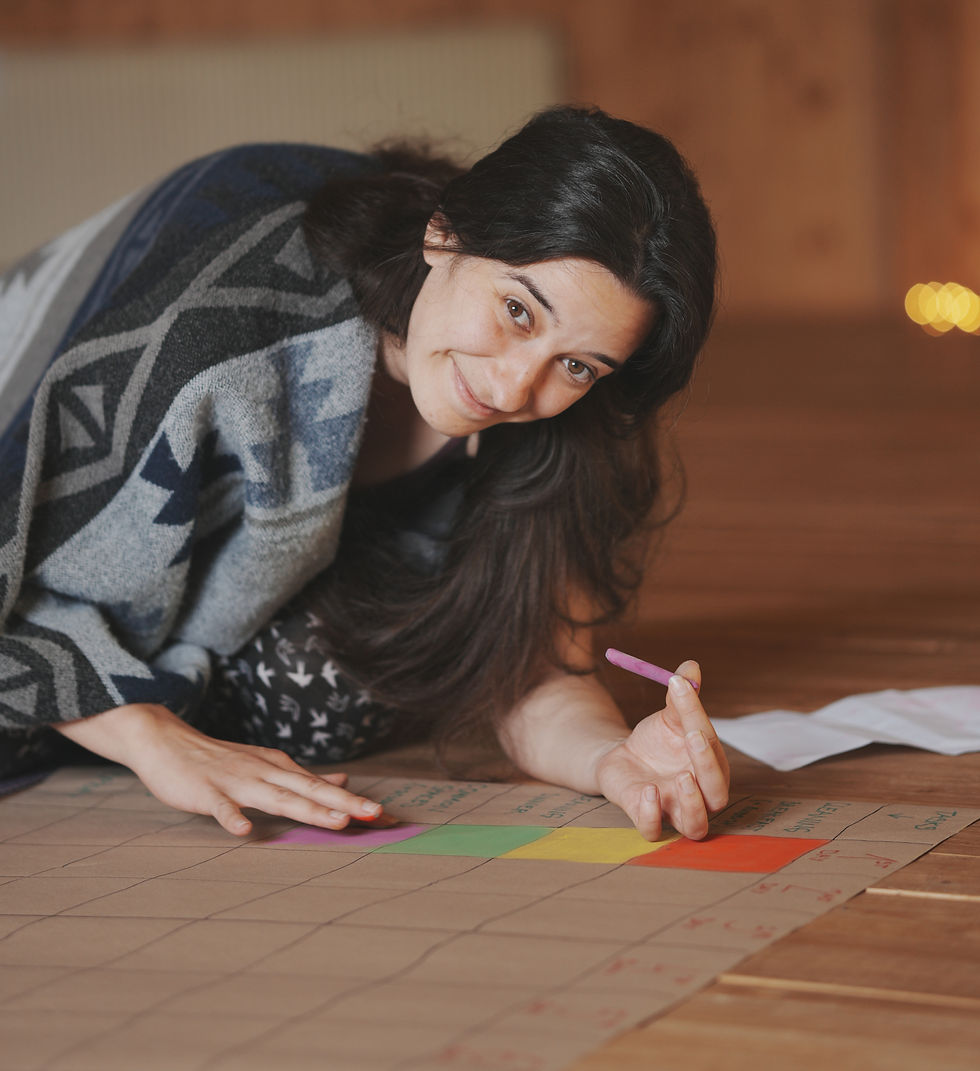

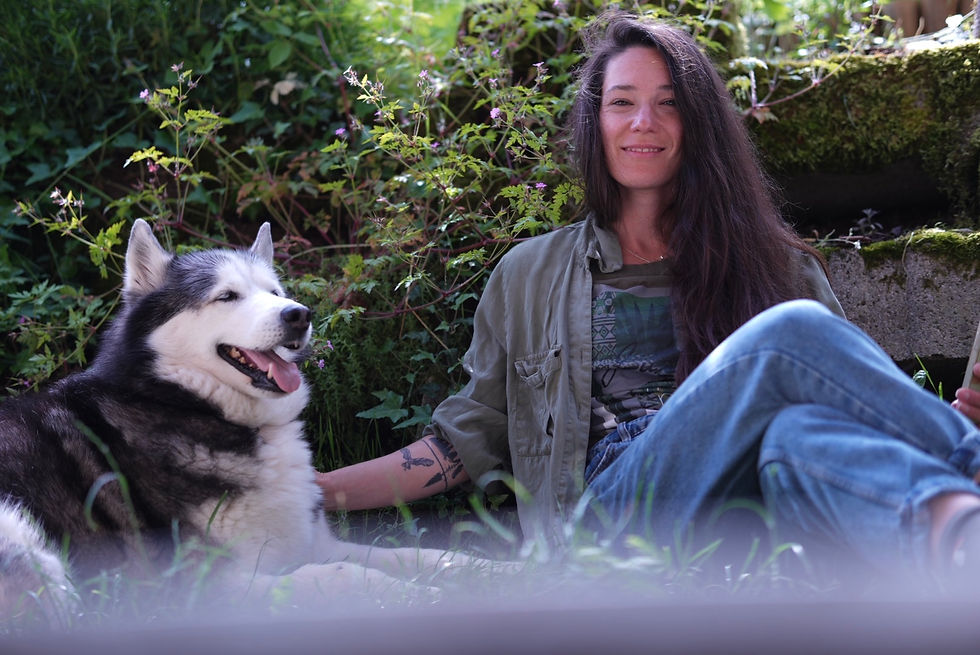
Neža is an artist, working as a freelance contemporary dancer and choreographer. Her artistic work is mainly focused on improvisational practices that include both the body and the voice. She is also interested in the therapeutic effects of the voice and the connective power of collaborative vocal-movement improvisation. She facilitates Intuitive singing workshops to invite people on a playful journey of reconnecting with their own voices.
"As an artist working with both movement and voice in collective improvisation, the space "in between" feels familiar to me. The more I allow myself to linger there, the more it unfolds as a fertile ground for discovery. In this in-between space, voice is no longer only sound and movement is no longer only form — they begin to permeate and transform one another. This space does not merely connect two disciplines or two people; it softens their boundaries of expression and thereby opens the possibility for something new to emerge. It invites uncertainty, vulnerability, and attentiveness. The “in-between” is not a compromise, but a threshold where a new language can take shape — where embodied sound and sounding bodies generate forms that neither voice nor movement could create alone, and where collective expression emerges as something more than the mere sum of its individual parts."
Živa is an anthropologist, manual therapist and researcher of somatic practices and contact improvisation. Her field of activity focuses primarily on developing and maintaining sensitivity and awareness towards oneself, fellow human beings and the environment, finding organic, creative and non-violent ways for the coexistence of differences and their mutual enrichment, which enables continuous transformation and personal growth. She uses work with the body, touch and awareness of space as the basic tools of her practices.
"I facilitate spaces where the body becomes a place of listening and inquiry. My work moves along the edges — between concept and sensation, word and movement, self and other, human and more-than-human worlds. Through somatic exploration, gentle encounters with touch, experimental bridges between disciplines, and reflective dialogue, I invite participants to linger at subtle thresholds where identity, perception, and relationship begin to shift. Inspired by ecological thinking, I am curious about how we meet not only one another, but also the landscapes and atmospheres we move within. I approach facilitation as tending a small ecosystem of attention — where bodies, words, and surroundings can breathe together. In these spaces, awareness widens beyond the individual. Curiosity grows like a path through unfamiliar terrain, and the quiet intelligence of the body becomes a guide — sensing place, connection, and the possibilities that live at the edge."
Nayeli is a psychologist working privately as a therapist with a Gestalt experiential psychotherapy approach. She has been a trainer in the field of non-formal education for more than 15 years. In the somatic and dance field, she is deeply inspired by contact improvisation, which has shaped her exploration of movement and its somatic approach beyond the dance studio. Having been actively engaged in the practice since 2017, she continues to investigate how this form expands her view on life.
"I see ecotones between humans as places of meeting with authenticity and inner allowance for expression. These spaces are alive and vibrant, since they offer chances where we can learn from each other's beingness and therefore build an inclusive view where everything different can be seen as curiosity rather than a threat. Nature is an inspiration for such spaces, inviting collaboration, harmony, and common support for growth. Boundaries are, therefore, places of meeting and respect. Touch is one of them. Not just skin to skin, but touch of presence, touch of curiosity, touch of compassion.
To be sensitive and sensible is a map for the exploration of new terrains in this wide ecosystem of togetherness.
Sabina Vilhelm and Lana Karina Crnohorski
Društvo Koru
Are our caring and nutritious cooking team. They are also passionate dancers and explorers of embodiment practices. Something that can be reflected in their way of cooking:
with presence, care and lots of creativity.


Project Partners:
Unfold e.V. - Germany